Commingled Inventory Is Ending: What It Means for Your Amazon Business
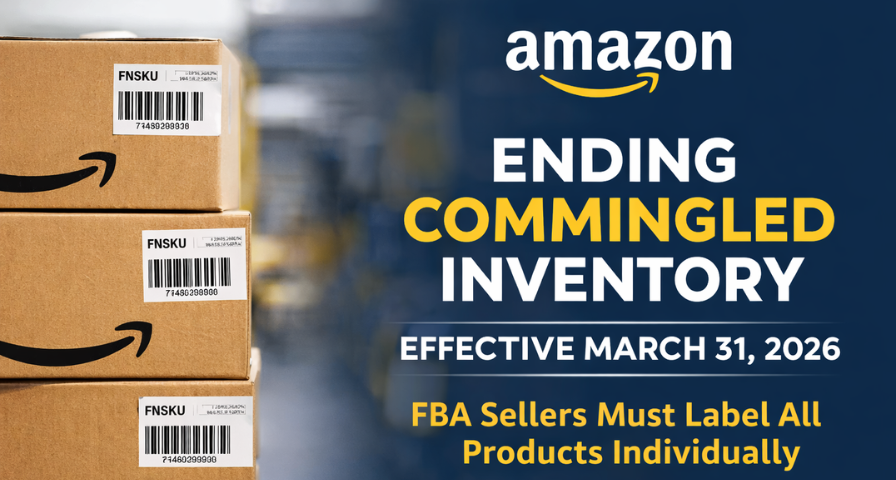
Amazon is ending commingled inventory on March 31, 2026, requiring all FBA sellers to use individual product labeling instead of stickerless inventory. This major update impacts how inventory is stored, tracked, and fulfilled across Amazon’s network. In this guide, learn what’s changing, why it matters, and how to prepare your business to stay compliant and competitive.
If you're a seller using Fulfillment by Amazon, you're used to a lot of policy updates, but most of them don’t have a significant impact on your business. This one does, however, because on March 31, 2026, Amazon is discontinuing commingled inventory, a feature that has been quietly affecting how millions of products are being shipped through their doors for quite some time.
To some sellers, particularly those who used stickerless inventory to save time and money, this is not a minor policy update. This change is significant, as it will impact the labeling, tracking, and shipping of all inventory throughout the entire FBA system. And if you're not aware of how to adapt, your shipments could be delayed, rejected, or even stuck.
In this article, we'll explain what commingled inventory is, why Amazon is discontinuing it, and most importantly, how you should adapt without affecting your business.
What Is Amazon Commingled Inventory?
The Amazon commingling of inventory, also called "stickerless inventory," is the storage of the same items from different sellers in the same bin in the Amazon fulfillment centers. The seller does not separate the items; instead, they separate them using the same manufacturer's barcode.
The product becomes the identifier in the commingling of the Amazon inventory. This means that if you and another seller have the same product and the same manufacturer's barcode, the items are interchangeable.
Here is an example of the commingling of the Amazon inventory. Let's assume you send 100 items of the popular LEGO toy to the Amazon fulfillment center in California. Another seller also sent the same LEGO toy to the Amazon fulfillment center in New York. When the customer in New York buys the LEGO toy, Amazon ships the next item in the bin, even though the item is from the other seller. In the background, the item is virtually transferred to you so you get the credit for the sale.
From a logistics point of view, it is an efficient system because it reduces shipping time and optimizes warehouse space for Amazon to deliver products more efficiently. From a seller's point of view, it also eliminates the need to label each product individually, saving preparation time.
However, such a convenient approach came with a price that could no longer be ignored over time.
Why Amazon Is Ending Commingled Inventory
Amazon’s decision to stop commingling is not made lightly. It is a response to a number of long-standing problems that impact not just customers but also sellers.
One of the largest problems is quality control. When Amazon commingles products from different sellers, it cannot ensure that every product shipped out is of equal quality. If one of the sellers has a number of counterfeit or damaged goods, those goods may be shipped to a customer who originally bought from a completely different seller. In essence, one seller is being blamed for problems that are not of their making.
Another issue is one of accountability. It becomes difficult to say which seller was responsible for a defective product when there is commingling. It also becomes difficult for Amazon to maintain quality control standards.
Amazon has also faced a number of problems related to transparency and product authenticity. Consumers want to be able to get the exact product that they ordered. Brands also want a certain level of protection from counterfeit goods. Ending commingling is one step towards having a higher level of control and ownership.
In simple terms, Amazon is prioritizing trust and traceability over operational shortcuts. That shift aligns with broader trends in e-commerce, where authenticity and brand protection matter more than ever. 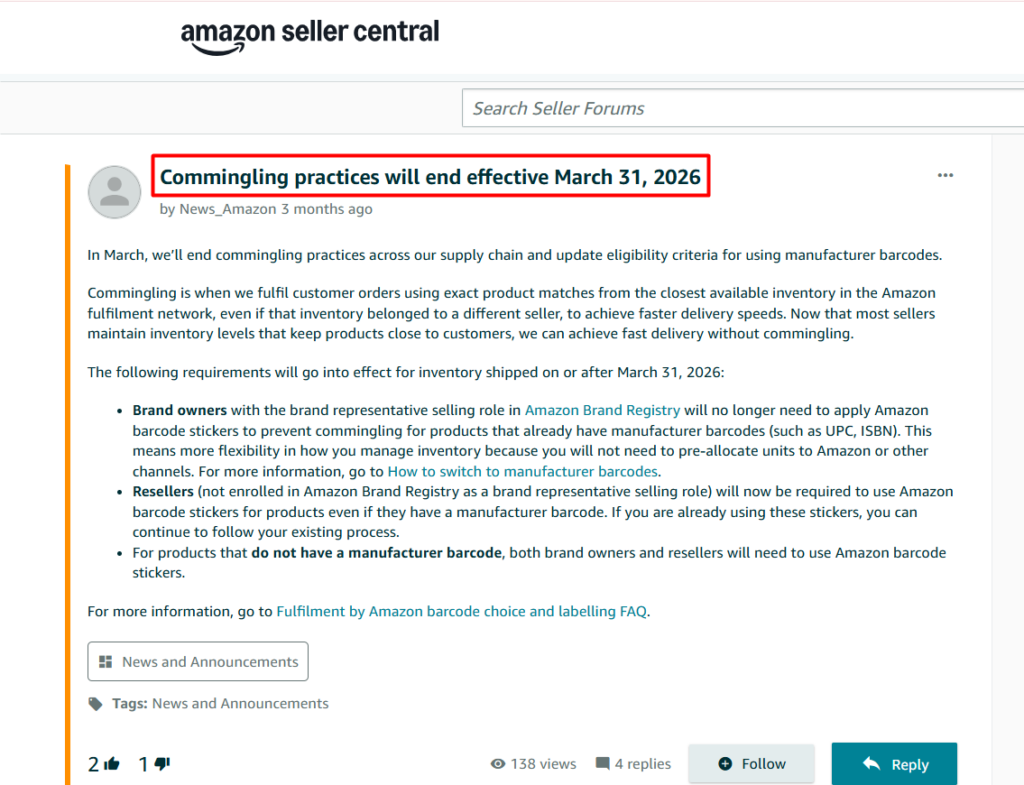
What Changes After March 31, 2026
Once the new policy takes effect, all FBA inventory must be individually labeled and tracked. This means every unit you send to Amazon must have a unique Amazon barcode, known as an FNSKU.
The biggest change is the end of stickerless inventory. You can no longer rely solely on manufacturer barcodes for FBA shipments. Each product must clearly identify you as the seller.
This also means inventory will no longer be pooled across sellers. Your stock remains your stock, stored and fulfilled separately from others selling the same product.
For sellers, this introduces a more controlled but slightly more complex workflow. Labeling becomes mandatory, prep requirements increase, and there is less flexibility in how inventory moves across the network.
At the same time, it reduces the risk of receiving negative feedback due to another seller’s poor-quality product, which has been a major frustration in the past.
Who This Impacts the Most
This update affects nearly every Amazon FBA seller, but some business models will feel it more than others.
Private label sellers may actually benefit the most. Since they already use unique branding and often rely on FNSKU labeling, the transition will be smoother. In fact, removing commingling strengthens their control over product quality and customer experience.
The wholesale and arbitrage sellers also have to adjust more carefully. These strategies usually involve the sale of the same branded items as the others. However, without commingling, the individual seller's items are treated separately. This eliminates some of the logistical benefits the wholesale and arbitrage sellers had before.
New sellers should pay close attention to the correct labeling and prep process. The goal is to avoid costly mistakes and delays.
Overall, the rule affects everyone, and the degree of disruption depends on how much you have been using the stickerless items.
The Real Impact on Your FBA Operations
The most immediate impact is operational. You will need to label every unit, either yourself or through a prep service. This adds time and cost, especially if you handle large volumes.
Shipping workflows will also change slightly. Since inventory is no longer pooled, distribution across fulfillment centers may require more planning to maintain fast delivery times.
On the positive side, inventory accuracy improves. You gain full control over what is shipped to your customers, which reduces the risk of negative reviews caused by someone else’s product.
Managing returns and customer complaints may become easier as well. This is because, when each unit is directly linked to your account, dealing with problems becomes simpler.
In the long run, this trend will lead to an increase in quality within the market. While this will be good for those who focus on quality, it may not be as good for those who have been focusing on quick fixes.
How to Prepare for This Change
The adjustment to this change is not so much about reacting to it at the last minute as it is about adjusting to it right now.
The first step in the process is to go through the current listings and determine which of the items currently have the manufacturer's barcodes rather than the FNSKU labels. This is the first step in the process.
The next step is to adjust the prep process. This involves determining whether you want to handle the labeling yourself or if you want to utilize Amazon's labeling option. This is something you should choose based on the scale of your operation.
The last step is to improve the quality of the quality control process. Because you're no longer mixing in other people's items, the quality of the items you're selling is directly correlated to the quality of the customer experience. This is a wonderful time to improve the quality of the customer experience and build trust with the brands you're selling.
The final step is to communicate with the suppliers. You should do this to inform them of the new changes and help with item labeling.
Why This Change Matters for the Future of Selling on Amazon
From a first look, it might appear to be a hassle to eliminate commingled inventory. The change will require additional steps and cost more. The process will also eliminate a system that many sellers have found useful. However, if you look at the bigger picture, the change will bring Amazon closer to a more transparent and reliable environment. Consumers will receive exactly what they have been expecting. The new policy will also provide more protection to brands. The change will also provide sellers with more control over their products. This initiative will also bring a shift in Amazon’s approach to balancing speed with responsibility. Speed will always be important. However, it will never be important at the expense of responsibility. This will be a fantastic opportunity for serious sellers.
Conclusion
The end of Amazon’s commingling of inventory in 2026 is a major shift in how FBA functions. What was once a shortcut is becoming a system of control, traceability, and quality.
If you plan ahead, this shift can help your business. It can help the system grow into one that is more organized and competitive.
The deadline is clear, and the path is set. Sellers who embrace this shift now will gain a significant advantage once it fully takes effect.
Ready to Grow on Amazon?
Let our experts help you scale your Amazon business with proven strategies.
Get a Free Consultation