Amazon Just Killed the Fake Strikethrough Price: What Every Seller Needs to Know
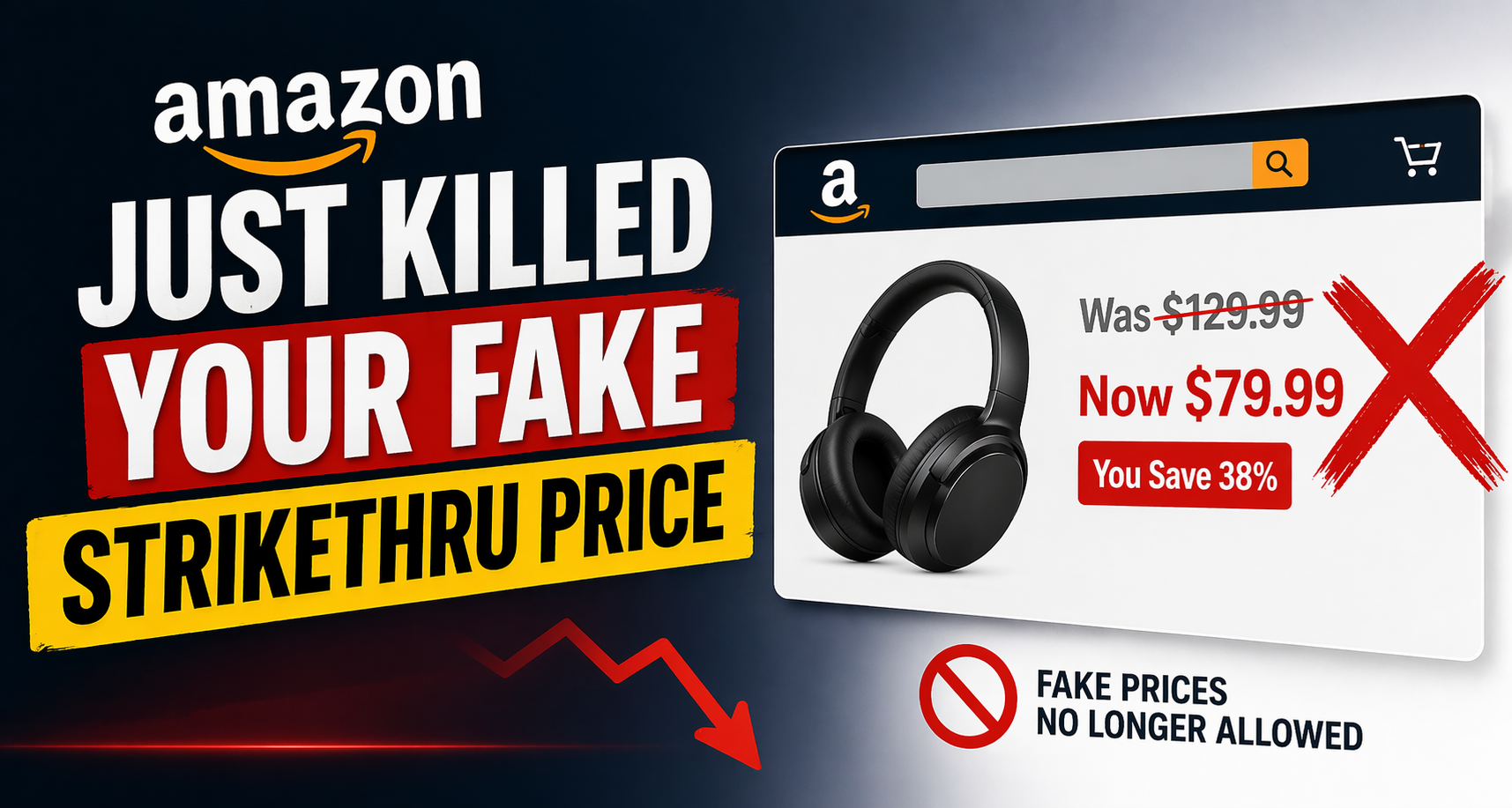
For years, a quiet trick has lived at the heart of Amazon's marketplace: the "Was $X / Now $Y" badge. Sellers discovered early on that parking an inflated List Price in Seller Central, one their product had never actually sold for, could manufacture the illusion of a discount powerful enough to move units. It was legal in the loosest sense, it was widespread, and it worked. Amazon is now pulling that lever out of sellers' hands entirely. Two pricing policy changes, one already live and one arriving in weeks, are about to reshape how the Amazon strikethrough price works and expose just how much of the marketplace's conversion activity was built on optical illusion rather than genuine value.
What Is the Amazon Strikethrough Price, and Why Did It Matter So Much?
The Amazon strikethrough price is the crossed-out number displayed next to a product's current selling price on a product detail page (PDP). It is very effective when paired with “Save X%” and is one of the most effective psychological triggers in e-commerce. Consumers interpret this as evidence of having made a good buy, and studies of consumer psychology have repeatedly shown that savings trigger purchases much better than just low prices.
The problem is that many sellers were gaming this system. By setting a list price, also called the reference price or MSRP, at a number their product had never legitimately sold for, they could display a dramatic discount badge without ever actually discounting anything. The product might have always sold at $29.99, but if the list price said $49.99, the PDP flashed "Save 40%." Shoppers had no easy way to verify the claim, and Amazon, for a long time, had limited mechanisms to challenge it.
Change #1: List Price Verification Is Live Now
As of April 23, 2026, Amazon has dramatically changed its methodology for verifying the list price in Seller Central. This means that the strikethrough price beside the price of your product will only show up if Amazon is sure that the list price is indeed real. In particular, the product should have been available to purchase at that price from some other reputable vendor. Alternatively, Amazon should have had at least one sale at that price as a Featured Offer.
If none of the two criteria are fulfilled, the strikethrough price is not displayed. No badge. No crossed-off price. No illusion of savings from MSRP. Your dream price that you've never charged anybody for is no longer considered a valid list price according to Amazon rules.
Such an approach to verifying prices brings Amazon into line with the Federal Trade Commission policy regarding reference prices in comparative advertisement, which states that any "former price" used as such should be the actual price charged for selling the product to customers. While many sellers used to follow the letter of Amazon's more liberal rule, they did not respect the FTC regulations. That's no longer the case.
Change #2: The Typical Price Recalculation Loophole Closes on May 18
The second change, rolling out May 18, 2026, targets a different mechanism called the Typical Price. The typical price is calculated as the median amount paid for a product over the previous 90 days, and until now it has excluded promotional sales from that calculation. This created an enormously useful loophole for sellers running ongoing coupons or Lightning Deals.
Here is how sellers were exploiting it: by running a coupon every week or nearly every week, the discounted price never touched the typical price baseline because promotional sales were excluded from the median calculation. The product's displayed "regular price" stayed high, the savings badge stayed fat, and the conversion lift from the perceived discount stayed intact, all while the seller was effectively running a permanent promotion.
From May 18, Amazon takes the promotional price into account when computing the typical price, provided that the price has been selling at that discounted rate for more than half of the 90 days. Put differently, if your product was available on promotion for more than half of those days, then it becomes the typical price.
Why Amazon Is Making These Changes Now
Two forces are converging to drive this shift. The first is legal. A proposed class action lawsuit filed in Washington state accused Amazon of using fictitious list prices, particularly during Prime Day, to mislead shoppers about the value of deals they were being offered. Separately, consumer protection regulators across Europe and in several U.S. states have tightened rules around advertised savings in e-commerce, requiring that "before" prices reflect genuine market prices rather than inflated reference numbers.
The second pressure comes from the business side. Amazon’s brand as an honest marketplace requires customers’ faith in the assertion that 40% off means 40% off. When enough customers feel that something is amiss in terms of pricing, they will start price checking elsewhere and won’t rely on those badges anymore, lowering their conversion rate. By doing this, Amazon has opted for customer trust in favor of the quick boost to conversion generated by misleading reference pricing on the seller level. As Prime Day 2026 looms on the horizon, Amazon seeks to be perceived as truthful.
How This Will Hit Conversion Rates
The sellers most exposed to these changes are those whose product detail pages rely heavily on the strikethrough and savings badge as primary conversion drivers. In split testing and conversion rate analysis across the marketplace, the "Was/Now" framing consistently outperforms pages without it, often by double-digit percentage margins. When that badge disappears without any other change to the listing, the creative, the images, the reviews, or the ad spend, conversion rate drops follow quickly.
Importantly, ad spend does not compensate for this. If your ROAS has been partially subsidized by the conversion lift of a fake strikethrough, you may find that the same ad budget now delivers fewer purchases at a higher effective cost. Sellers who attributed their performance to great product-market fit may discover that the badge was doing more work than they realized.
What Sellers Should Do Before May 18
The practical response to these changes requires honest internal auditing before the platform forces the issue. Start by reviewing every ASIN where a list price is currently set. Ask when the product last actually sold at that number. If the answer is "never" or "not within the past year," plan for that strikethrough to disappear and model what the PDP conversion rate looks like without it.
Secondly, analyze the promotion frequency by SKU. In case any of the products has already been offered coupons or other promotional offers more than 50 percent during their recent 90 days cycle, then the average price of the SKU is expected to decrease post-May 18. It would be advisable to work out pricing strategy for those SKUs on the new baseline price rather than responding to the situation after the badge goes away and conversion suffers.
It might also be useful to know that there are certain promotional offers that may not be considered when calculating reference price. Promotions such as "Buy X, get Y," "Subscribe and Save," and highly targeted promotions may not affect the recalculating mechanism. The promotional pricing for Prime Day also might be excluded from this process. Having an idea about which promotions protect the reference price baseline can help with strategic planning.
Lastly, find out which listings have the most dependency on the strikethrough pricing and consider taking preemptive actions. Those listings can be identified as the most risky. Repricing, reformatting the offer, and investing in organic conversion can help avoid conversion problems when the badge is gone.
The Bigger Picture for Marketplace Sellers
What Amazon is doing here is drawing a line between sellers who built genuine price discipline into their strategy and those who borrowed credibility from fictitious reference prices. Sellers who have consistently priced products at a sustainable level and used promotions sparingly will find that their strikethroughs survive, because the numbers were real. Their competitive position on the PDP may actually improve as competitors who gamed the badge lose it.
For the greater marketplace at large, this represents a long overdue remedy. The use of the false strikethrough price was widespread: rational for the individual seller implementing it and detrimental for the collective trust of the consumer that makes the whole system worthwhile. Amazon is finally putting into practice what transparent pricing could and should have been from the beginning.
Those sellers that will weather the storm most effectively will be those that understand this as a message and not a punishment. Those relying on created discounts in order to close their conversions know well that the shift coming this spring can only serve as a catalyst to develop a compelling value proposition.
Ready to Grow on Amazon?
Let our experts help you scale your Amazon business with proven strategies.
Get a Free Consultation