Amazon Receiving Delays: What Sellers Are Experiencing and Why It Matters
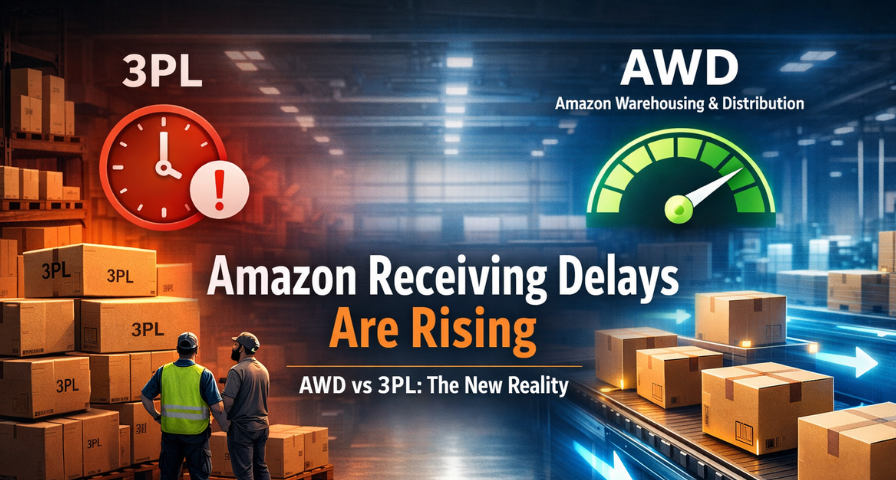
Amazon receiving delays are no longer random, they are becoming a pattern. Inventory is arriving but sitting idle, with slower check-in and stowing times, especially for shipments coming from 3PLs. This points to a bigger shift, Amazon is prioritizing its own logistics network, particularly AWD, over external inbound flows. The result is simple, faster movement for AWD inventory and increasing delays for 3PL shipments. For sellers, this directly impacts availability, conversion rates, and overal
In the course of your business in the past year, you may have experienced an issue that seems minor at first but can turn into a major issue. The packages will reach the warehouse, yet the inventory will not be available on the expected schedule. The inventory remains unused, check-in becomes a slow process, and the process of storing goods seems to take longer than before.
It might seem like an everyday operation issue at first. However, the repetition of this issue in different shipments and from different sellers indicates a shift in the operations strategy of Amazon.
The Pattern Sellers Can’t Ignore
Over the last year, two operational issues have become increasingly common across Amazon FBA workflows. Inventory that has already been delivered to fulfillment centers is sitting in a received status longer than expected, and the time it takes for units to move from check-in to stowing has noticeably increased.
This issue extends beyond peak season and isolated warehouses. Sellers across different categories and regions are reporting similar experiences. The delays are consistent enough that they are no longer random.
One pattern that seems to stick out above all others is that packages being delivered by third-party logistics companies, often referred to as 3PLs, seem to be experiencing delays at a greater frequency and for longer periods of time than deliveries from other sources.
A Shift Toward Amazon’s Own Logistics Ecosystem
As can be observed in recent years, Amazon has made significant investments into their logistics infrastructure. In particular, Amazon has introduced the concept of Amazon Warehousing and Distribution (AWD). Using AWD, sellers can stock bulk inventory into Amazon's upstream distribution and replenish FBA centers as needed.
For Amazon, AWD is a very effective way of solving several problems. First, it helps them maintain more control over the inventory flow, decrease reliance on third parties, and improve forecasting and placement optimization. Second, AWD goes well with the company's goals of creating an integrated supply chain.
Considering everything mentioned above, the reasons behind recent delays become much clearer. AWD ensures that Amazon logistics processes shipments faster than those from external companies, particularly 3PLs.
It should be noted that the company doesn't try to penalize any of its 3PLs. On the contrary, they are simply focusing on optimizing their logistics process.
Why 3PL Shipments Are Slower Right Now
There are a few practical reasons why shipments from 3PLs might be experiencing slower processing times.
First, external shipments require more verification. Amazon needs to validate labeling, quantities, and compliance more rigorously because the inventory is entering from outside its controlled network. This adds friction at the receiving stage.
Second, warehouse capacity is not unlimited. When fulfillment centers are under pressure, Amazon has to decide how to allocate resources. It is reasonable to assume that inventory already within its own system, such as AWD stock, is easier and faster to process.
Third, Amazon’s algorithms likely play a role. Inventory that is part of its internal distribution flow may be prioritized because it aligns better with demand forecasting and placement optimization.
All of this results in a simple but important reality. Not all inbound inventory is treated equally anymore.
The Real Impact on Your Business
Initially, a delayed reception does not seem like much. However, practically speaking, receiving delays negatively affects you in various ways.
The first issue is its availability. Your inventory is not ready for sale until you receive and store it. That means you will encounter availability gaps, even though you actually have goods in Amazon’s storage.
Availability gaps translate into lower conversion rates. Your listings will go into an out-of-stock position and become less available. Once you lose ranking, it will take a while to recover, as well as significant investments in ad budget, etc.
There is also a financial aspect. Idle inventory means that your capital gets tied up but doesn’t produce profits. At the same time, you keep spending on storage and inbound fees with no gains whatsoever.
Eventually, such delays can influence all the supply chain planning processes. You will find forecasting increasingly difficult, and managing reorder timing will become problematic.
Why This Trend Matters Long Term
However, it also indicates the general trend Amazon is trying to steer its sellers toward regarding its logistics network.
Obviously, Amazon is encouraging such behavior where it will make sure its inventory stays in its system as much as possible. This is an important aspect that goes beyond the AWD usage but rather applies to inbound transportation as well.
Such an aspect creates a certain dilemma among Amazon's sellers. Should they continue using 3PL services and incur associated delays, or should they try to integrate with Amazon's logistics services instead?
The failure to adapt to this trend may cause a company to lag behind its competitors.
What Sellers Should Be Doing Right Now
The first thing that needs to be done here is to change the timing. By sticking to outdated receiving timetables, you are risking underestimation of the time needed for the product to reach the consumer. Sending early will create a safety margin that will account for any unexpected delays.
Secondly, one should start testing the Amazon warehousing and distribution services in parallel with the current third-party logistics company's system. You don't have to immediately shift all of your operations to a new system. Running tests can provide useful insight regarding performance.
Thirdly, one should track their product deliveries more carefully. It is important to consider all steps of the process, including delivery, receiving, and storage. This information will help you manage your inventories better.
Lastly, it may be useful to consider logistics risk management when choosing an optimal solution. Relying solely on one particular method in a constantly evolving environment is risky. Diversification and gradual shifting towards faster logistics methods may prove beneficial.
Balancing Control vs Speed
Another critical factor is control. Most sellers favor the use of 3PL providers for their flexibility and customization. However, AWD is less flexible and more connected to the Amazon process.
The balance is beginning to make sense. 3PL providers allow sellers better control, while AWD provides speed and reliability in the Amazon network.
The choice will ultimately be determined by each seller's individual needs. Volume sellers with high dependency on availability will find that AWD works better for them. Other sellers may need to continue using 3PL providers but be more aggressive about it.
Conclusion: Adapting to Amazon’s New Reality
Amazon’s receiving delays are not just a temporary issue. They reflect a deeper shift in how inventory is prioritized and processed within its network.
The pattern is clear. Inventory flowing through Amazon’s own systems is moving faster, while external shipments, especially from 3PLs, are facing more friction.
For sellers, the shift means one thing. You need to adapt.
Earlier shipping, testing AWD, and optimizing your logistics approach have ceased to be a matter of optimization; they are becoming mandatory steps to preserve your conversion rate, keep you available, and remain competitive.
Those merchants that understand this trend and adapt their approach will be in a better position compared to those that fail to realize the trend early enough.
Ready to Grow on Amazon?
Let our experts help you scale your Amazon business with proven strategies.
Get a Free Consultation