Amazon's Rufus Is Quietly Billing Sellers for AI Prompts on Their Own Product Pages
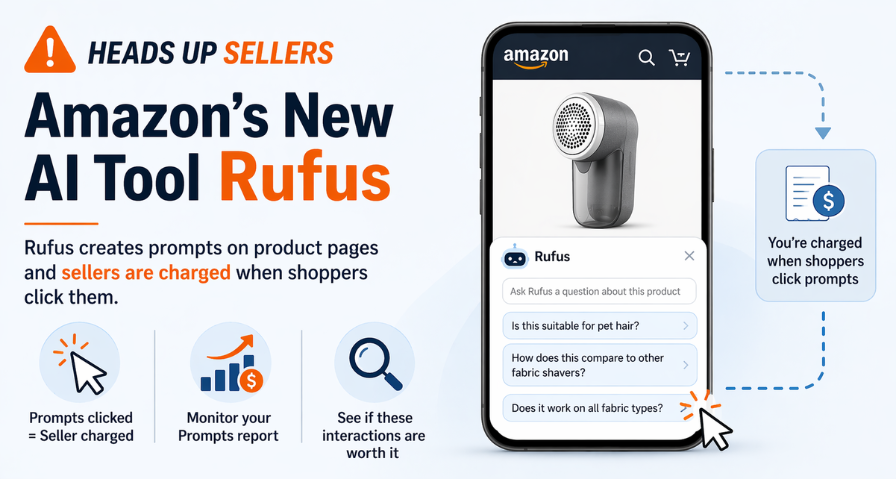
Amazon is certainly no stranger to introducing innovative features that change how shoppers view products online. The new feature Amazon introduced, Amazon Rufus, certainly fits this description – although in a manner quite different from what most sellers had envisioned. The once promising innovation was supposed to revolutionize the e-commerce landscape via an advanced shopping assistant powered by artificial intelligence technology. But things soon began to look different as reports started trickling in from concerned sellers about unanticipated spending linked to "prompt clicks" by Amazon Rufus on their product listings.
Reports are starting to surface from sellers who noticed unusual charges tied to “prompt clicks” generated by Rufus directly on their product listings. These are not traditional ad clicks driven by search results or sponsored placements. Instead, they are interactions happening inside the product page itself, often triggered by AI-generated suggestions. The problem is not just the cost, it is the lack of clarity around what sellers are actually paying for.
This shift signals something bigger. Amazon is quietly redefining how engagement is monetized, and many sellers are only realizing it after seeing unexplained spikes in their ad spend.
A new AI-powered feature is generating charges that many sellers never agreed to, often with no sales to show for it. Here is what is happening and what you can do about it.
1,815 Prompt clicks one seller was charged for
$2,941 Cost incurred from those clicks
70% Of clicks that produced zero sales
88% Of one day's spend hit all at once, without explanation
What is Amazon Rufus, and why does it matter to sellers?
A new shopping assistant called Rufus, which uses artificial intelligence technology, was launched by Amazon. It is supposed to serve as a conversational AI tool for helping people buy things by asking questions and comparing products. While it seems useful from the consumer point of view, from the standpoint of sellers, there is an unaccounted-for fee that appears unexpectedly in the advertisements' statistics.
What happens is that this AI program gives a list of questions or subjects connected with that particular product on its page. The issue arises in the fact that when a buyer clicks on such a prompt, the seller gets billed as though that was a click on the sponsored product, although the client had visited that page and was reading something posted by the seller himself.
"Customers who were already on the product page, engaging with seller-written content, generated billable clicks. No new discovery. No new intent. Just a charge."
The real cost: nearly $3,000 with most clicks going nowhere
One seller's reported experience has become a cautionary example for the broader community. They were charged for 1,815 prompt clicks, totaling $2,941 in ad spend. Of those clicks, 70 percent resulted in zero sales, meaning the majority of that budget produced no return. On a single day, 88 percent of the total spend arrived in one concentrated burst, with no explanation from Amazon about what triggered the spike.
What makes this especially frustrating is the nature of what is being charged. These were not clicks from customers who discovered the product through a search ad. Many came from people who were already viewing the listing, which raises a legitimate question: what exactly is Amazon charging for, and does it represent any meaningful value to the seller?
The transparency gap Amazon has not addressed
At the center of this issue is a data problem. Amazon currently provides no clear breakdown of whether Rufus-related prompt clicks are actually driving incremental sales, returning customers, or any measurable outcome that justifies the charge. Sellers are being asked to absorb a new cost category without the reporting infrastructure to evaluate whether it is worth paying for.
This is a meaningful gap. In a well-functioning ad platform, every click type comes with performance context: conversion rates, attributed revenue, and comparison benchmarks. Without that, sellers cannot make informed budget decisions. They are effectively flying blind on a charge that can quietly accumulate in the background of a normal campaign.
Why this feels different from standard sponsored products
Amazon seller advertising has always carried the understood contract: you pay when a shopper discovers and clicks your product through a sponsored placement. The assumption is that the click reflects intent, curiosity, or discovery from someone who would not have found you otherwise. Rufus-generated prompt clicks disrupt that contract.
When a customer is already on a product page, the seller has already done the work of earning that visit. Billing for an AI prompt interaction that occurs during that same session, using content the seller created, stretches the definition of what a sponsored click is supposed to represent. Whether Amazon intended this outcome or not, the effect is that sellers are paying for engagement that does not clearly map to the original promise of sponsored advertising.
What sellers should do right now
The most immediate step is visibility. Many sellers are not aware this is happening because Rufus-related charges are buried inside existing sponsored products reports rather than surfaced separately. Opening the Prompts report inside Amazon Seller Central's advertising dashboard is the starting point for understanding whether this is affecting your account and at what scale.
Once you have that data, the question becomes: are these clicks converting at a rate that justifies their cost? If your Rufus prompt click conversion rate is well below your standard sponsored product performance and Amazon is not offering a mechanism to opt out or control the spend, that is worth escalating through Seller Support with documented evidence. The seller community has historically moved Amazon on transparency issues when the feedback is specific and organized.
In the shorter term, monitoring daily spend spikes is essential. The reported case of 88 percent of spend hitting in a single day is not a billing irregularity you would catch without active monitoring. Setting up spend alerts and reviewing campaign-level daily budgets can help limit exposure while you assess the impact.
"Sellers do not currently have enough data to evaluate whether Rufus prompt clicks are worth the cost. That is the core problem Amazon needs to solve."
The bigger question for Amazon's advertising ecosystem
It shows an underlying conflict that arises whenever such features of artificial intelligence have been incorporated into a monetizable surface without reconsidering the way value and costs have been calculated. Rufus by Amazon could actually assist shoppers in making purchase decisions. However, the issue here is not the usefulness of the feature. The problem lies in the way the costs associated with it are being billed.
Sellers work on thin profit margins. A feature that could bill sellers thousands of dollars without giving any data on whether the expenses yielded profits or not would only weaken the trust that advertisers put in the platform in making their investments. Amazon boasts of having an ecosystem that rivals some of the best advertising platforms in the world. At least it should be able to explain the costs related to Rufus with such transparency.
Conclusion, Stay Alert and Stay Analytical
While Amazon Rufus is a great product, it brings too many questions at the moment compared to any clear insights. The notion of improving customer experience using AI is quite reasonable however, the monetization approach is causing confusion among the sellers.
So, what do you need to remember? There is no doubt that every new addition cannot be regarded as useful. Monitor your performance, think about unexpected spending, and stay aware of the final result and how things develop.
Sellers who monitor everything from the very beginning will get ahead, while the rest will see how their profit becomes lower without knowing the reason behind it.
This is one of those situations when being aware is more important than taking actions. Just follow developments closely and do everything according to the data.
Quick action checklist for sellers
1. Open Seller Central and navigate to Sponsored Products reports.
2. Locate the Prompts report and review click volume and spending.—how
3. Calculate the conversion rate on prompt clicks vs. standard sponsored clicks.
4. Set daily spend alerts to catch any unexplained spikes early.
5. Contact Amazon Seller Support with documented data if charges appear unjustified.
Ready to Grow on Amazon?
Let our experts help you scale your Amazon business with proven strategies.
Get a Free Consultation