From Rufus to Alexa: Amazon’s Big Bet on AI-Powered Shopping
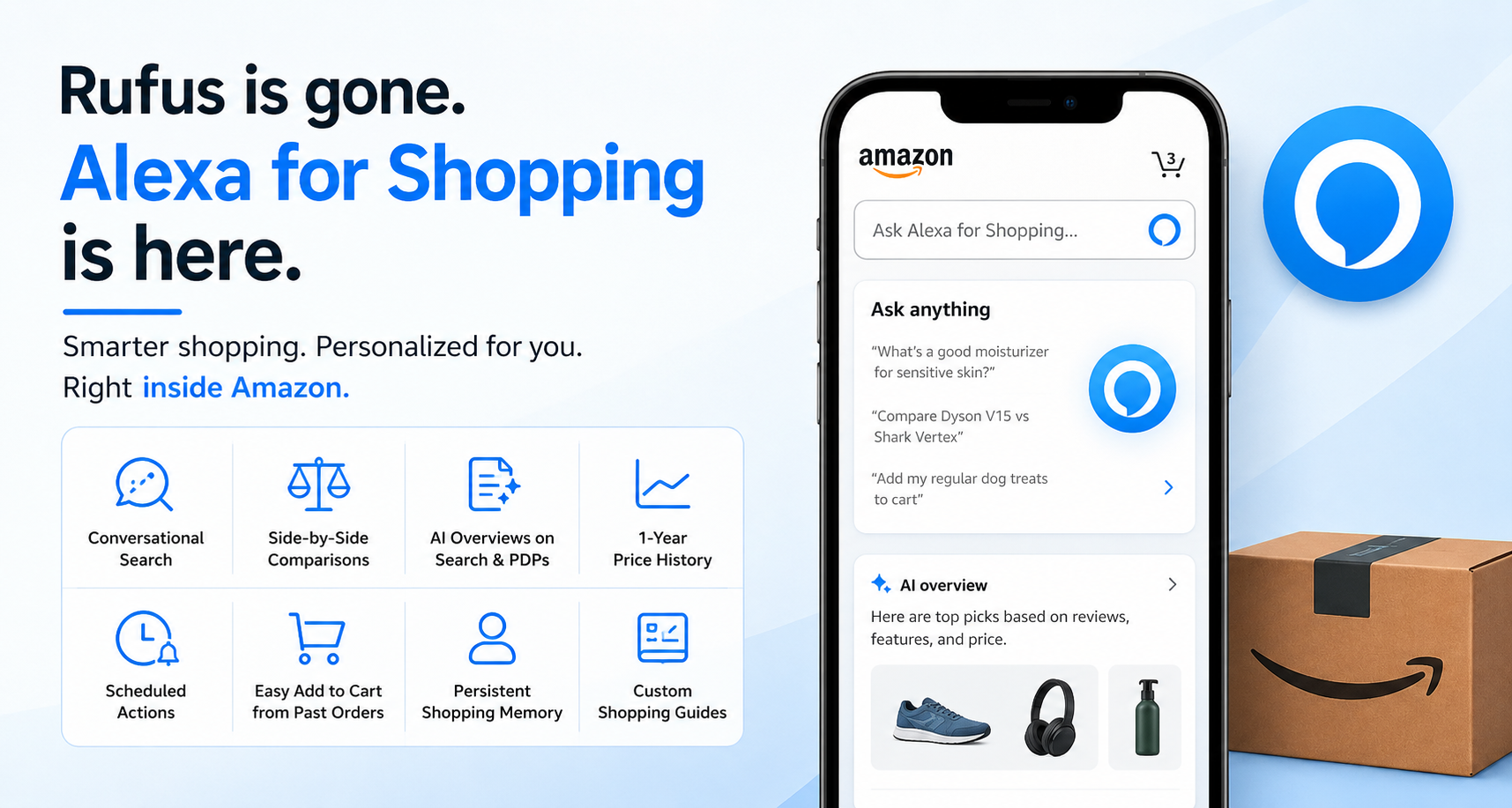
It was an almost imperceptible change, but one that indicates a much larger trend in the making. On May 13th, Amazon did not simply change the name of Rufus but transformed the entire process of online shopping. What began as an AI assistant specifically meant for shopping purposes now exists within a more complex platform known as Alexa for Shopping.
While at face value this may seem like a minor change in branding, it is a significant strategy developed by Amazon in response to increasing threats. The emergence of AI-driven discovery has caused customers to drift from conventional keyword searches in favor of asking questions, comparing products, and even making decisions without having visited the marketplace.
What Actually Changed
The most important change is not the name. It is the consolidation. Amazon merged Rufus, which handled shopping queries, with Alexa+, which handled broader assistant tasks. The result is a unified assistant embedded directly into the shopping experience.
Now, every signed-in Amazon customer has access to Alexa for Shopping. There is no need for an Echo device, no requirement for a separate app, and no Prime membership barrier. The assistant lives inside the search bar, product pages, and mobile app, making it impossible to ignore.
The decision was reinforced by impressive internal numbers from Amazon. In just the year 2025 alone, 300 million customers have interacted with Rufus. This product helped generate an additional $12 billion in annualized sales, with those who used it being much more prone to making a purchase. Clearly, this kind of clout can only mean one thing. No longer is it an experiment; it is now the entry point.
Rufus is no longer in beta. Alexa for Shopping is now the front door of Amazon.
Why Amazon Made This Move
TTo understand the timing, you have to look outside Amazon.
AI tools are changing how people shop. Instead of browsing listings, users are asking platforms like OpenAI-powered interfaces for recommendations, comparisons, and summaries. These tools remove friction. They also reduce the need to visit Amazon directly during the discovery phase.
That is a direct threat to Amazon’s dominance in search-driven commerce.
Amazon has been successful in recapturing this lost ground by integrating Alexa for Shopping within its platform. This guarantees that consumers perform product discovery and comparisons and make decisions right there in the Amazon universe.
The Evolution of the Search Bar
One of the most crucial shifts is taking place right before our eyes. The search box is not simply a box where you put in a few keywords anymore. Rather, it serves as a means of communication.
Users can now type out complicated and natural language queries. As opposed to just entering "best yoga mat," they could ask, "I am looking for an inexpensive yoga mat that offers knee protection for beginners." This will trigger the understanding of the intention behind the question and then direct it to Alexa for shopping.
This represents a significant shift in product discovery. Keyword optimization remains vital, but it is no longer sufficient alone.
Smarter Product Comparisons
Another significant improvement is side-by-side comparisons. Consumers can pick up multiple products and have Alexa give a comparison of the features, prices, and reviews for the products.
This addresses the trend of people using AI technology to compare different products before heading over to Amazon. People can now do everything on Amazon without having to look elsewhere first.
For sellers, this means your product will not just compete on visibility. It will compete on clarity. If your listing does not clearly communicate value, the AI will struggle to position it favorably in comparisons.
AI Overviews and Decision Shortcuts
Summary snippets generated by AI have been added to Amazon searches and product pages as well. This gives users an overview of the most important aspects, including typical advantages and disadvantages and overall trends within the product category.
It makes life easier for buyers who do not want to go through multiple bullet points and product reviews.
On the flip side, the seller does not have full control anymore about how the story of the product is being presented. The AI will determine what information it includes in its summary based on the data it has.
Price Transparency Gets an Upgrade
There is no longer the need to rely on third-party sites when it comes to price history. It is now possible for buyers to access up to a year's worth of price history directly from Amazon itself or even from Alexa.
This brings a whole new level of transparency into the equation. It is easy to tell if the offer is indeed an offer or simply a mark-up and then a reduction.
The Rise of Agentic Shopping
One of the more intriguing aspects of the service is scheduled actions. The client has an option to set conditions for making a purchase. For instance, the request could be made that Alexa place a product in a customer's basket only if its price falls below a certain threshold and the customer has not bought it within a specified period.
In this case, we see some automated decision-making processes. The purchasing cycle is now outsourced to the system to some extent.
Demand management is now different. Rather than reacting to promotions, customers have an opportunity to set up their purchasing pattern.
Personalization Through Persistent Memory
The Alexa for Shopping technology now stores customer preferences over time. These include needs of the family, food restrictions, brand choices, and behavioral aspects.
Consumers can even check on what the system knows about them.
This kind of personalization enhances relevance, yet it also increases the standards of sellers. Items that match with the user's behavior and preferences will get more priority. The others might not even see the light of day.
In essence, relevance is not only about keywords anymore; it is about context.
Custom Shopping Guides and Cross-Platform Influence
Personalized shopping guides can be created for complex categories by Alexa. Comparisons are made in terms of features, prices, and reviews not only within Amazon but also across the entire web.
This is an important paradigm shift since Amazon understands that customers do not function in an isolated environment. They conduct research outside of Amazon too, and Amazon is attempting to offer that research experience inside.
In terms of competition for sellers, it now does not only include listings on Amazon.
What This Means for Sellers
The key learning here is that Amazon is evolving into a platform where decisions are made through AI rather than through search.
This means that a different strategy is needed to succeed in such an environment. Products should be listed in a manner that enables AI to extract the most relevant information. It means highlighting product strengths, providing clear specifications, and generating reviews.
High-quality content becomes crucial for success. Ambiguity not only means that there is room for improvement but is, in fact, a weakness that will be magnified by AI.
Lastly, sellers should think about the performance of their products in a comparative manner because consumers can compare their choices immediately.
The Bigger Picture
This move is not just about Amazon. It reflects a broader shift in digital commerce.
The traditional funnel is changing. Discovery, evaluation, and purchase are becoming compressed into a single conversational flow. AI is acting as both guide and gatekeeper.
Companies that control this layer will shape how decisions are made.
Amazon’s integration of Alexa for Shopping is a clear attempt to own that layer before others do.
Conclusion
It did not vanish. It grew stronger and more coherent. The Alexa for Shopping tool signifies a change in the way people engage with Amazon, switching from searching to dialogue and from exploring options to making decisions.
As far as sellers go, this is much more than an upgrade. It is a fundamental transformation in how products get discovered and selected. Companies that respond by ensuring greater clarity, relevancy, and accuracy in their information will win out. Others, using outdated techniques, might soon find themselves becoming less visible.
What matters now is not achieving a high search ranking. It is about being recognized, recommended, and trusted by artificial intelligence.
This is the new paradigm, and it has already begun.
Ready to Grow on Amazon?
Let our experts help you scale your Amazon business with proven strategies.
Get a Free Consultation