Rufus Knows Who You Are: How Amazon's New Identity Layer Is Rewriting the Rules for Sellers
For years, Amazon search felt like a meritocracy of sorts. You optimized your listing, earned your reviews, sharpened your conversion rate, and the algorithm rewarded you with visibility. The query was the thing. Two shoppers typing the same keyword got, more or less, the same shelf. That era just ended.
Amazon has quietly rolled out a feature inside its AI shopping assistant Rufus called "Tell us about you." Spotted first by Ritu Java and surfaced publicly by Vanessa Hung on April 22, the feature invites shoppers to describe themselves in plain language. Their lifestyle. Their home setup. Their family. Their hobbies. Whatever they want Amazon to know. Rufus saves that description as a persistent identity profile, tied directly to the account, and that profile travels everywhere the shopper goes, across every search, every Alexa interaction, every device, every session.
The query stays the same. The identity layer underneath it changes everything.
What "Tell Us About You" Actually Does
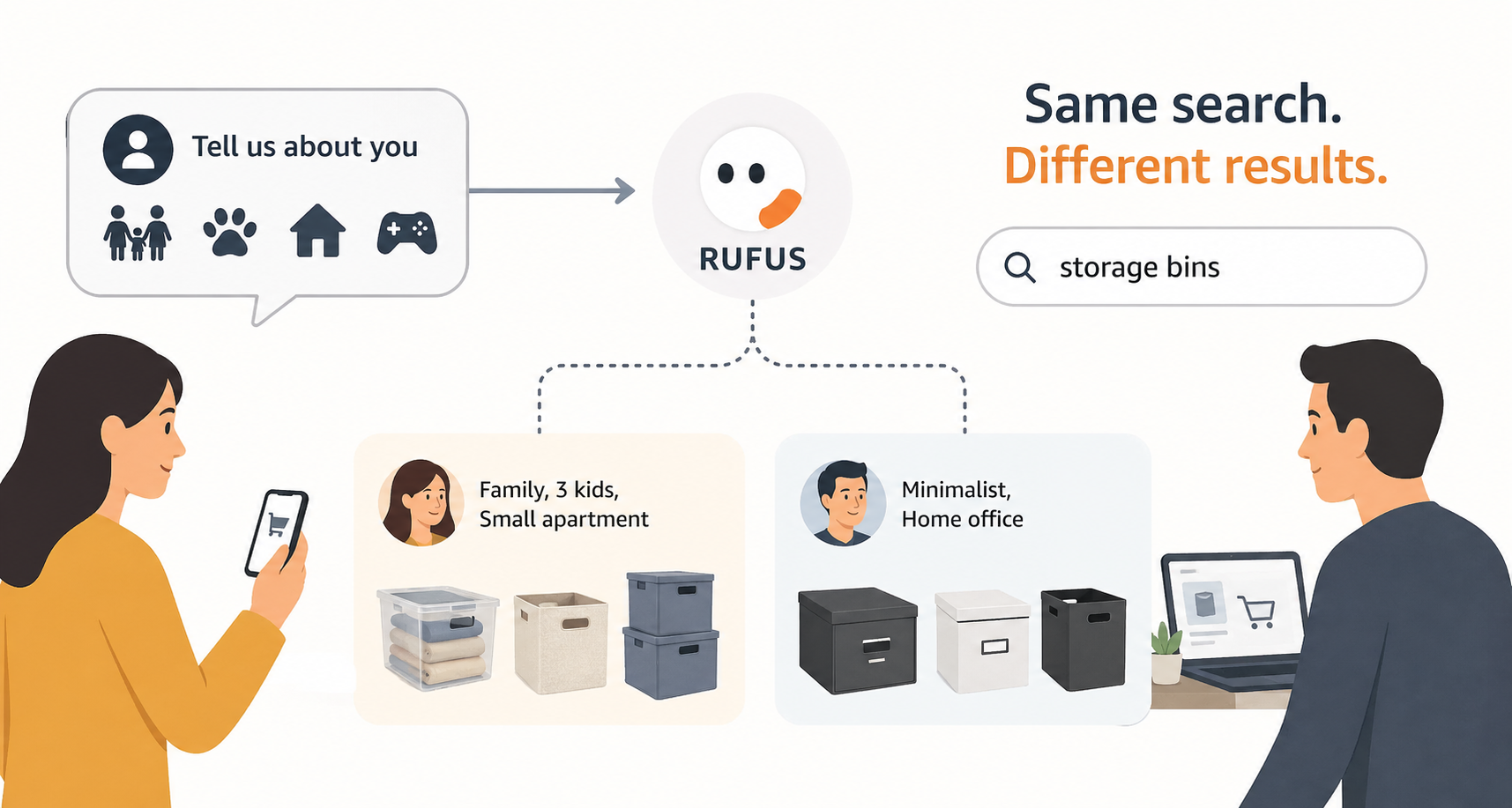
The execution is simple enough, but the ramifications are significant. A customer logs in to Rufus and writes a self-description: three kids, tiny apartment in the city, striving for organized simplicity. Another customer logs in to Rufus and self-describes: home office, no kids, appreciates a clean aesthetic. Both customers then use Rufus to search for “storage bins.” Same keywords, but different results. Different ASINs. Maybe even different brands.
This is not Amazon delivering varying advertising messages based on demographic groups to which a customer belongs. Rather, this is Amazon's AI reading the self-authored customer identity profile and using it to understand the actual intention behind the query. Depending on who made the query, the meaning of the word "storage" will differ. Rufus can recognize this customer.
By introducing a self-authored preference graph into its customer profiling arsenal, Amazon has created a radically new kind of personalization tool, one in which the user directly shapes the profile through their own self-description rather than the behavior Amazon infers.
The Scale Makes This Impossible to Ignore
But before we get ahead of ourselves on what the sellers will have to change, let’s reflect for a moment on just how significant the Rufus effect already is. In 2025, 300 million customers used Rufus. Rufus generated $12 billion in additional sales. Year-over-year growth in monthly active users was 149 percent. Interaction rates went up by 210 percent. Customers who interacted with Rufus achieved conversion rates 60 percent higher than those who did not.
And it is that last figure that sellers should find truly eye-opening. Rufus is not a passive chatbot in a corner of the app; it is the entranceway through which millions upon millions of increasingly enthusiastic Amazon consumers enter. And those consumers see personalized results based on who they are according to Amazon.
Why This Changes the Listing Game for Sellers
The old playbook had three pillars: keywords, reviews, and conversion rate. Those signals still matter, and they are not going anywhere. But a new layer now sits between the search bar and your ASIN, and that layer asks a question your current listing may not be answering: who is this product for?
Rufus is now reading your bullets, your A+ content, and your backend keywords not only to match them against a search query but also to match them against a stored human profile. The product that wins is the one that maps cleanly onto the shopper's self-description. A listing that says "designed for families with young children" is an anchor point. A listing that says "built for small home offices" is an anchor point. "Ideal for pet owners in apartments" is an anchor point. These are phrases that Rufus can directly map onto what a shopper has already told it about themselves.
A spec sheet cannot do that job. Dimensions, materials, and feature lists written with no human context in them are effectively invisible to the profile-matching layer. It does not matter how precisely you ranked on the keyword if the AI reading your copy cannot connect your product to the kind of person who is searching.
What Sellers Should Audit Right Now
The most urgent shift for sellers is moving from product-centric language to person-centric language. This does not mean abandoning technical accuracy. It means surrounding your specifications with human context that gives Rufus something to anchor against.
Look at your primary bullets and ask: do any of these sentences name the person who would buy this? If your bullet says "heavy-duty construction with reinforced corners," that is a feature. If it says "heavy-duty construction with reinforced corners, built for households that go hard on their gear," that is a feature with a person attached. The difference is small in word count. The difference in profile-matching relevance is significant.
A+ content is another high-leverage surface. It tends to get written as a brand story or a feature showcase, but it now needs to function as identity mirroring. Imagery and copy that reflects recognizable lifestyles, parents managing busy households, professionals optimizing compact workspaces, pet owners navigating small living rooms, gives Rufus richer material to match against shopper profiles.
Backend search terms have always been the invisible plumbing of Amazon SEO. Consider using some of that real estate for persona-adjacent language, lifestyle descriptors, and life-stage signals rather than pure synonym stacking.
The Bigger Shift: From Keyword Matching to Identity Matching
What Amazon is building here is not just a smarter search engine. It is a system where the shopper's identity is itself a ranking signal. The brand that understands its buyer persona with precision and then writes copy that speaks to that persona in plain, recognizable language is the brand that Rufus will surface when the matching happens.
This rewards sellers who have done the customer research. Not the generic "our buyer is aged 25 to 45" research, but the granular, empathetic understanding of how your customer describes their own life and what problems they are actually solving when they buy your category. If you know your buyer tells people she is a "new mom in a one-bedroom apartment trying to stay organized," and your listing has language that maps to that description, you are now structurally advantaged in a way that a competitor with better keyword density but no persona language cannot easily overcome.
This is a meaningful shift in where Amazon's personalization intelligence now lives. It used to live in behavioral data that Amazon collected passively. It now also lives in the words shoppers choose to describe themselves, openly, in a chat interface. That is qualitatively different data, and it carries different weight.
What Comes Next
One could safely assume that this capability would continue to develop even further. After all, Amazon has made huge investments in the development of Rufus, and statistics show that it is paying off. Extending the profile across different platforms, including Alexa, the Amazon app, and later on through actual stores, seems like the most obvious step forward. The identity layer, which begins with "Tell us about you," will most definitely expand its capabilities.
For sellers, the window to adapt early is open right now. Most listings on Amazon are still written for the keyword index and the human eye skimming a product page. Very few are written with the profile-matching layer in mind, because that layer barely existed a month ago. The sellers who restructure their copy to speak to identifiable human personas over the next few months will be ahead of the curve when Rufus-driven traffic becomes the dominant force it appears to be heading toward becoming.
The query used to be everything. Now the query is just the entry point. The person behind the query is what Rufus is actually reading. Make sure your listing knows how to speak to them.
Ready to Grow on Amazon?
Let our experts help you scale your Amazon business with proven strategies.
Get a Free Consultation