Understanding the Amazon Business Solutions Agreement Update and What It Means for Sellers
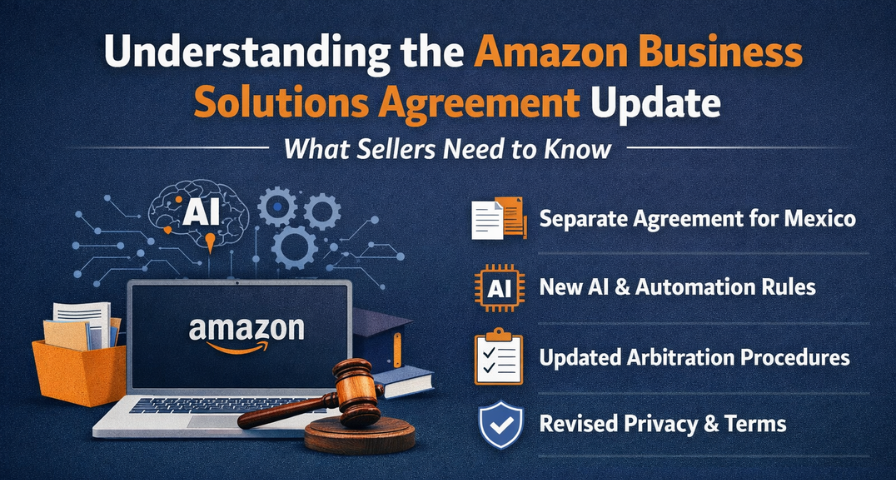
E-commerce As an Amazon seller, you are required to sign a legal contract known as the Business Solutions Agreement. This is a contract that many sellers do not think about again until something goes wrong. However, when Amazon updates this contract, it is not a usual process. This update can affect how you conduct business, the services you are able to use, and the process of resolving disputes.
The new update for the Amazon Business Solutions Agreement brings a lot of changes to the structure and policies. The most significant changes are in the AI services, automation services, and marketplace agreements. If you are using software that helps you with pricing, inventory, advertising, or data analysis, this update is for you.
What Is the Amazon Business Solutions Agreement?
The Amazon Business Solutions Agreement is the basic agreement between Amazon and its sellers. It outlines your rights, obligations, limitations, and procedures for resolving disputes. Each seller account is governed by this agreement.
When Amazon changes this agreement, it is not just polishing language. It is also reshaping lines. Such changes may impact how you utilize Amazon’s infrastructure, how you integrate third-party services, and how you handle legal or compliance matters.
Learning about the changes to the Amazon seller agreement is part of running a sustainable business on Amazon.
A Separate Agreement for the Mexico Store
One of the changes in the Amazon Business Solutions Agreement update is the separation of the Mexico store into its own agreement. Before, mentions of Mexico were included in the general North America structure.
With the separate Business Solutions Agreement for Mexico, Amazon is now making it clear what jurisdiction and marketplace-specific terms apply. The mentions of Mexico will be removed from the US and Canada agreement, and some Canada-specific language is being clarified.
Why is this important? When there are multiple marketplaces with separate agreements, sellers have to review each one separately. Assumptions about similar terms in different regions can lead to compliance issues. If you sell in multiple marketplaces, you now have to consider each agreement as its own legal construct.
New AI and Automation Rules
The most pertinent aspect of this Amazon policy changeover has to do with AI and automation. Amazon is making it crystal clear that it is going to exercise more control over how its data and systems are accessed.
The new terms of the agreement clearly state that sellers cannot use Amazon data or services to train or develop AI models. This is a clear reaction to the explosion of generative AI and automated data extraction tools. Software companies have been using marketplace data to improve algorithms, pricing models, and predictive analytics. Amazon is making it clear that there is a line that cannot be crossed.
Reverse engineering Amazon systems is also more explicitly prohibited. Trying to decipher ranking algorithms, backend systems, and system dynamics through automation is no longer encouraged.
The New Agent Policy and Identification Requirements
The Amazon Business Solutions Agreement Update brings about more defined terms regarding what Amazon considers to be “Agents.” This would include AI software, bots, and automated systems that interact with Amazon’s platform.
All AI software and automated systems accessing Amazon must identify themselves as automated systems. They must also follow Amazon’s new Agent Policy and immediately cease accessing Amazon if Amazon asks them to. Amazon also reserves the right to limit or prevent access to AI software that does not comply.
This has serious implications for sellers. Many sellers use repricing software, listing optimization software, PPC automation software, inventory management software, and analytics software. If this software does not comply with Amazon’s new terms, your account is at risk.
The onus is on the seller. Even if the software that failed to comply is from a third-party service, the seller account is still at risk.
This is important because automation is now a key part of any modern ecommerce business. Amazon is not forbidding automation but is instead requiring transparency and control.
Why Amazon Is Tightening AI and Data Access
The timing of this update to the Amazon seller agreement regarding Amazon’s restrictions on AI usage is not coincidental. The adoption of AI in ecommerce has accelerated quickly. The capabilities of AI have reached the point where data scraping, product listing, bid optimization, and competitor analysis are possible at scale.
From an Amazon standpoint, the risks associated with the use of AI on the platform are several. There is the risk of system exploitation, algorithm manipulation, and misuse of proprietary information. Amazon is ensuring that its data is used in a controlled manner for AI model training by requiring the identification of agents.
This is a trend that is being seen in digital ecosystems. Large platforms are changing the way external systems interact with their infrastructure. Data control and system access are becoming strategic priorities.
The important point for sellers is that compliance is becoming more technical. Sellers need to understand how their tools work.
Dispute Resolution and Arbitration Clarifications
Another important aspect of the update to the Amazon Business Solutions Agreement is the addition of a new section that describes procedures for dispute resolution.
Binding arbitration remains in place, and the class action waiver remains valid. But the amount of information about arbitration procedures has been expanded. This new language makes it clear what those procedures are, what the timeframes are, and what the rules are.
While most sellers hope to never have to rely on this section of the agreement, it is very important to understand what this section means. Disputes with Amazon will not go to court. They will go to arbitration as described in the agreement.
If you are a larger seller or a larger brand, it is a good idea to review this section of the agreement with an attorney.
Updated Privacy Language and Terminology
The Amazon policy update also contains changes to the wording of the privacy notice. While this may appear to be a trivial matter, the wording of the privacy notice is often consistent with other regulatory requirements.
The definition of “Developer Site” has also been changed to “Solution Provider Portal.” New definitions have been introduced, including Agent, Applicable Government Authority, and Our Materials.
Definitions in legal contracts carry significant weight. They determine how the contract will be interpreted and enforced. If your business involves developers, service providers, or integration, these new definitions may have an impact on how obligations are allocated.
The definition of insurance limits has also been changed. Sellers who are required to carry commercial liability insurance should check whether the requirements or limits of coverage have changed.
What This Means for Amazon Sellers
The Amazon Business Solutions Agreement update is more than just housekeeping. It is a move towards a more controlled approach when it comes to data usage, automation, and structure.
For the seller, this means a move towards more responsibility. The use of AI and automation software is still permitted, but transparency and compliance are now required. Lack of knowledge about your software’s usage of Amazon’s systems is no longer an excuse.
It also means that multi-marketplace sellers need to be more aware of separate agreements. While clarity from Amazon is helpful, it also means that more attention needs to be paid to reviews.
Finally, the emphasis on arbitration procedures in the updated agreement means that disputes are still subject to specific contractual procedures. Knowledge of these procedures before a dispute arises is part of good business practice.
Preparing for the Changes
If you are dependent on automation in your Amazon business, the action step is straightforward. Read the new agreement carefully. List all the tools that connect to Amazon on your behalf. Verify that these tools are in compliance with the new Agent Policy and identification rules.
Contact the software vendors and ask for a letter of compliance. Verify your insurance coverage is in line with the new definitions. This is a compliance check, not an update.
It is not about fear. It is about maintaining continuity.
Final Thoughts on the Amazon Business Solutions Agreement Update
The update to the Amazon Business Solutions Agreement represents a definite shift in Amazon’s approach to managing its ecosystem. With the distinction between marketplace agreements, the reinforcement of AI usage policies, the definition of agent obligations, and the enhancement of arbitration information, Amazon is establishing control and order.
This is a time for sellers to take a step back and reassess. While AI and automation are still very effective, they must be contained within specific parameters. The message from the platform is that transparency and compliance are not optional.
The most successful sellers are early adopters. They understand the rules and work within them. By examining the updated agreement today, sellers can avoid disruption tomorrow.
If your Amazon business is founded on principles of long-term stability and not short-term gains, this update is not something to fear. It is merely the next step in the evolution of a developing online marketplace.
Ready to Grow on Amazon?
Let our experts help you scale your Amazon business with proven strategies.
Get a Free Consultation