Your Rank Means Nothing. Your Market Share Means Everything.
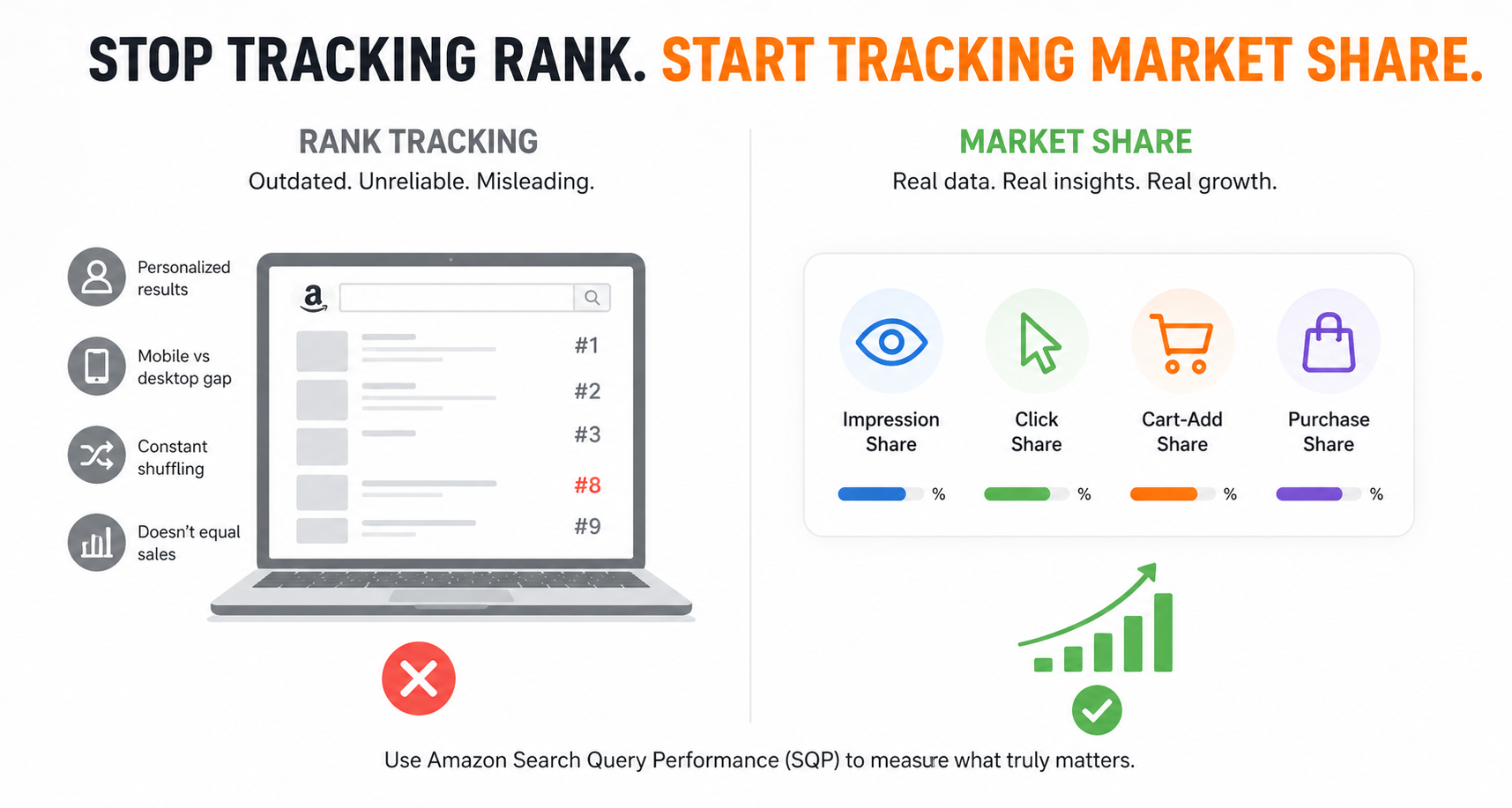
Such reasoning was useful for many years when marketing goods via Amazon as it was believed that keyword ranking served as a yardstick. Good news was when a product made it up from position ten to three, while bad news was when a product lost its ranking status. However, this is not so anymore.
There are countless factors that play a role in making Amazon a very dynamic, personal environment, meaning there's no way to know what search results people will see when using Amazon's search engine. And yet, many companies continue to rely on tracking keywords despite their increasingly irrelevance.
There has been a move away from considering ranks and trying to estimate metrics when it comes to maximizing the output on Amazon, and this shift towards market share must be accepted if you want to generate sales and grow.
Why Rank Tracking No Longer Reflects Reality
The concept of “the rank” is inherently flawed since it is based on the assumption that there can only be one ranking of the search results on the whole. On Amazon, however, the search engine works in an individualized manner – meaning that the results will be affected by a particular customer’s browsing habits, purchasing behavior, geographical position, device used, etc.
Therefore, your product’s listing will not have one specific rank but thousands or even millions of different ranks, depending on the customer’s search habits. Rank trackers that use desktop scraping techniques are unable to capture the full picture because they operate within the limited framework of the same dataset each time.
With the rise of the mobile market share, this issue became even more important. Now most users visit Amazon via their phones, where the presentation and location of items and ads may vary considerably compared to the desktop version of the website.
The question of volatility must also be raised. Amazon regularly changes the positions of products within its search results for testing purposes. A product can go from position four to twelve to six again within a very short time frame. This is Amazon testing, and it is nothing more than that. But when a team reacts to daily fluctuations of this kind, it ends up making unnecessary changes that do more harm than good to the product’s performance.
Finally, it should be noted that ranking no longer determines business success. Products sell through sponsored ads, brand store placements, external traffic, and subscriptions, among other methods. Ranking tracking only considers one aspect of the process and neglects many others.
The Problem with Chasing Rank
In other words, if rank were stable, it would be a poor indicator nevertheless. Rank reflects visibility, yet visibility does not necessarily translate into action. Even if a product holds the top ranking position within a certain keyword, it might be a keyword with insignificant search volume, which will have a marginal effect on sales.
On the other hand, a competing brand may control more search volumes than it is necessary for its own needs and thus gain more clicks and conversions despite a slightly worse ranking position. Hence, rank provides an illusory picture of success when in reality the company fails to keep up with competitors.
Ranking position is only one link in the chain of important factors, and it is several steps removed from the desired outcome. It is a metric for measuring visibility, which is measured by traffic, which, in turn, generates sales. The further down we go along this chain, the less reliable the connection becomes.
This is the reason so many companies are dissatisfied with their results.
The Shift Toward Market Share Thinking
Modern Amazon strategy requires a different perspective. Instead of asking “What is my rank?” the better question is “How much of the market am I capturing?”
Market share reflects your actual position within the competitive landscape. It tells you not just where you appear, but how effectively you convert that visibility into clicks, cart additions, and purchases.
This approach aligns directly with revenue growth. It focuses on outcomes rather than proxies. It also provides a more stable and actionable view of performance, since it is less affected by short-term fluctuations and personalization noise.
The challenge, historically, has been access to reliable data. Third-party tools attempted to estimate share using scraping and modeling, but those methods inherit the same limitations as rank tracking. That is where Amazon’s own data changes the game.
The Real Tool: Search Query Performance
Amazon has quietly provided a far more powerful solution through Search Query Performance (SQP), available inside Brand Analytics for sellers with Brand Registry. Unlike external tools, SQP is built on first-party data, meaning it reflects actual shopper behavior across the platform.
Instead of guessing, SQP shows you exactly how your brand performs across its top search queries. For each query, you get four key metrics that reveal your true market position.


Impression share helps you understand what percentage of exposure you have on average by telling you how often your listing appeared out of all listings appearing during a particular shopper's query search of a keyword.
Click share determines the frequency with which your listing was clicked by shoppers, meaning how attractive it is with regard to your competitors.
Cart-add share provides information about how often customers decided to add an item from your listings to their shopping cart, signaling their intention to buy.
Finally, purchase share gives you the percentage of all sales made by customers who performed a particular query search.
In conclusion, these metrics help you understand the whole chain of events that happens with a customer starting from a search till the purchase.
Why SQP Changes the Game
One of the main benefits of using SQP is the ability to be accurate. Since SQP relies on the data from Amazon itself, there won't be any interference with the scraping limit or an artificially created environment. It will reflect actual customers and their actions.
The next significant benefit of using this metric is the stability. While ranks are likely to change day-to-day due to testing and customization, share metrics usually become stable during a specific period of time.
This means that the metric has some historical context since it may be used for up to 2 years. This means that you will be able to spot patterns, seasonal trends, and other changes that happen within the long period of time.
Moreover, SQP works perfectly well alongside other Amazon strategies. For example, it is easy to optimize listings and prices according to the results of SQP analyses.
How to Use Market Share Data Effectively
The analysis of data is one thing, but the true power of data comes with its implementation. If your impression share is too low, the problem is that of visibility. This means that your ads are probably underfunded, have poor bidding rates, or insufficient organic SEO. In this case, efforts need to be directed at increasing exposure.
If the impression share rate is high, while the click share rate is still poor, then the problem must lie in your listing. This means that there is something about your images, titles, or pricing that makes it less attractive than others.
If there are many clicks but the shares of additional products or purchases remain quite small, then the conversion is the issue here. The problem could be negative feedback, poor description, or discrepancy between customer expectations and reality.
It means that using this strategy in measuring the effectiveness of your activity, you will be able to diagnose and solve any problems that arise much better.
Moving Beyond Outdated Metrics
The move from ranking tracking is not an attempt to do away with the use of metrics. Instead, it’s a move towards the adoption of newer measures that can capture how Amazon currently operates.
Rank tracking served a purpose when Amazon was relatively simple. However, basing the company’s success on such measures at this stage would be similar to following an out-of-date map, as it will lead to nowhere fast.
Market share, through the use of metrics like SQP, provides a more precise measure for assessing success. Such metrics link to actual revenues and provide meaningful information.
Conclusion
Times have changed for Amazon, and the KPIs associated with it will not be as relevant anymore. Rank tracking is not an effective way of measuring performance due to the current state of things where personalization, mobility, and multiple channels are the new reality.
The way forward would be with brands that concentrate on results. Using search query performance and concentrating on the share of your market, you get a better perspective of your performance and how much more room there is for growth.
It is no longer about ranking high. It is all about having the majority of the market.
Ready to Grow on Amazon?
Let our experts help you scale your Amazon business with proven strategies.
Get a Free Consultation